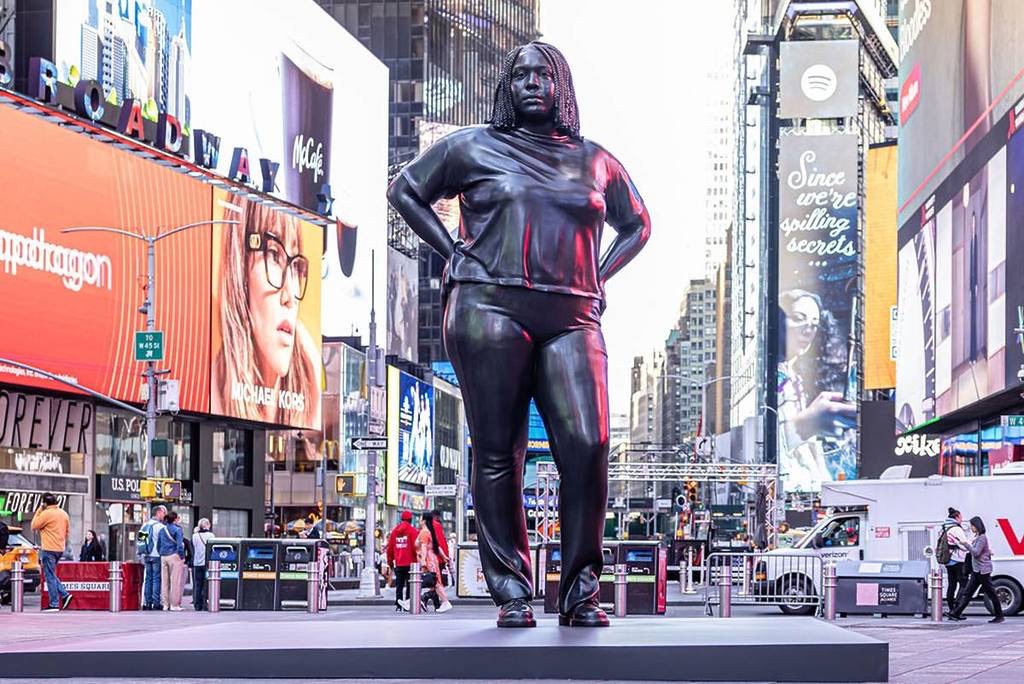
On April 29, 2025, the Times Square Art Program debuted a piece titled “Grounded in the Stars”. The reveal uncovered a 12 foot bronze statue depicting an everyday, plus size Black woman with locs. The unveiling quickly sparked discourse across social media. Droves of Black women shared their grievances, referring to the figure as ugly and masculine. Some couldn’t fathom how this sort of Black woman could be represented in an art show. Months later, discourse regarding Black women and desirability swirled around the internet once more. In this instance, however, women discussed the hardships that stem from being conventionally unattractive. In response, legions of conventionally attractive Black women activated their platform to combat these remarks. They insisted that public assertions of ugliness were unwise to make, especially on social media. Ironically enough, the crowd that loudly took issue with the statue and women recounting their own personal experiences somewhat overlap.
A woman’s beauty is widely understood as a necessity. Through media and day to day life, the importance of a woman’s attractiveness is repeatedly reinforced. There are clear incentives for women to leverage their looks. Whether these perks include easy access to romantic partnerships, economical opportunities, or positive attention, beauty is undoubtedly pedestalized. Society also continues to maintain beauty’s incomparable importance through algorithms primarily platforming attractive, easily digestible faces. Black women often find themselves excluded from these conversations due to white beauty standards. But what happens when a Black woman finds herself not only on the fringes of white desirability, but Black beauty standards, too?
Regional desirability has been well documented by Black women. A number of us have discussed our perceived insignificance in predominantly white or non-black cities. However, most Black women residing in major black cities have little trouble finding themselves at the receiving end of desire. Black people have made great strides to appreciate our own unique, cultural beauty. However, some may find it difficult recognizing the strife numerous Black women endure when they are conventionally unattractive. In many spaces, including Black ones, failing to attain beauty or a certain aesthetic can feel alienating. Within any social setting, a woman’s beauty is her main source of social capital. Productive conversations around colorism, texturism, and featurism have steadily increased within the black community. However, there are still Black women who aren’t visually palatable enough to reap the benefits of the progress we’ve made.
Additionally, Black women in the public eye represent the difficulties of obtaining current beauty standards. Many past celebrities fell victim to chasing after European beauty standards, undergoing several cosmetic procedures to achieve a look congruent to white women. Inversely, Black women more aligned with urban culture went under the knife for differing reasons. In the 2010’s, the BBL craze coveted a more curvaceous shape. Ones who found themselves unable to attain this certain body type were overlooked and deemed “bad built.” To avoid ridicule and profit off of beauty’s capital, famous women fell in line and adapted to the new landscape. Mean spirited social media platforms targeting Black women failing to achieve this aesthetic set the new standard in motion. Throughout the decade, countless regular women underwent procedures and intense workout regimens to emulate the changing tide. Moreover, numerous cultural critics have specifically discussed Instagram’s hand in cultivating the newest ideals of beauty for Black women. Seductive makeup, long wigs, and facial features extracted from us with a touch of racial ambiguity all embody the “Instagram” face. This phenomenon has shaped the public’s expectation of a woman’s appearance. Due to the repetition of this specific image, any representation divesting from the new norm was bound to experience questioning and scrutiny. For notable Black women, achieving this look was imperative.
In 2025, we are witnessing the pendulum swiftly swing back to coveting thin bodies, but with a twist. Instagram and other social media platforms still boost images of the “Instagram face” and curvy bodies, as long as it comes in a smaller frame. As the decade persists, women are afflicted with more rigid expectations due to the combination of these aesthetics. For Black women, the pressure to conform has already traveled across the media. Women aligning themselves with white sensibilities, while also being palatable to social media, are slowly morphing their aesthetic to an amalgamation of the 2010’s and 2000’s. Social media is ubiquitous, with online expectations trickling its way into our real lives. The 2020’s teeter a thin line between body consciousness and rabid criticism in a manner the public has never encountered. The art we consume, like the statue stated in the beginning, challenges the representation we’ve grown so accustomed to. With women often adhering to the silent demand of desirability, no wonder a piece like “Grounded in the Stars” is controversial to the masses. The depiction amasses deep frustration because a plus size Black woman is not attempting to perform the desirability we normally seek. She only has one function: to simply exist within the space.
Women loudly discussing their experience being unattractive typically brings great discomfort. Being consistently overlooked and treated poorly due to one’s looks can feel like a societal failure, on their part and ours. We understand that women possessing any sort of beauty is a necessity, so our knee jerk reaction is to disprove any claims opposing that. However, when an unattractive woman loudly states her frustrations, with countless first hand experiences to support her argument, we shouldn’t silence her. Black women, regardless of where they sit on the beauty hierarchy, are often excluded from the idealized image of femininity. Why are we afraid to confront the notion that conventionally unattractive Black women face this tenfold? Reckoning with the ebb and flow of beauty standards, societal pressures of femininity, and conventionally unattractive Black women’s exclusion and alienation from innumerable spaces could result in progressive discourse. Instead, we put a bandaid over a social issue that everyone can see, but too discomfited to directly address.


 21st Century Black Woman
Leave a comment